The Oudekloof Pass - entering Tulbagh Valley
Entering Tulbagh Valley
Our Route starts with two passes, leading from the Wellington area, past Gouda, to Tulbagh. The oldest dates from as early as 1658, just six years after the arrival of Jan van Riebeeck at the Cape.
But why was there such an urge by Van Riebeeck to find a way to the north? It was partly to barter cattle from the Khoi, and partly to find out the truth about the mythical places, such as Rio do Infanta and the great city of Monomotapa, which he had read about.(1)
But to move northwards from the Cape, one had to cross a formidable mountain barrier – whether in the east, north-east or north. In March 1658, Van Riebeeck sent Sergeant Jan van Harwarden to find a pass across "the mountain range of Africa", as Van Riebeeck called these formidable peaks.
Van Harwarden's party travelled from Cape Town, via Tygerberg, then past Koeberg on the west coast, past Riebeek Kasteel, and came to the Great Berg River. They spent a few days wandering about the Wagenmakers Valley, where Wellington is now.
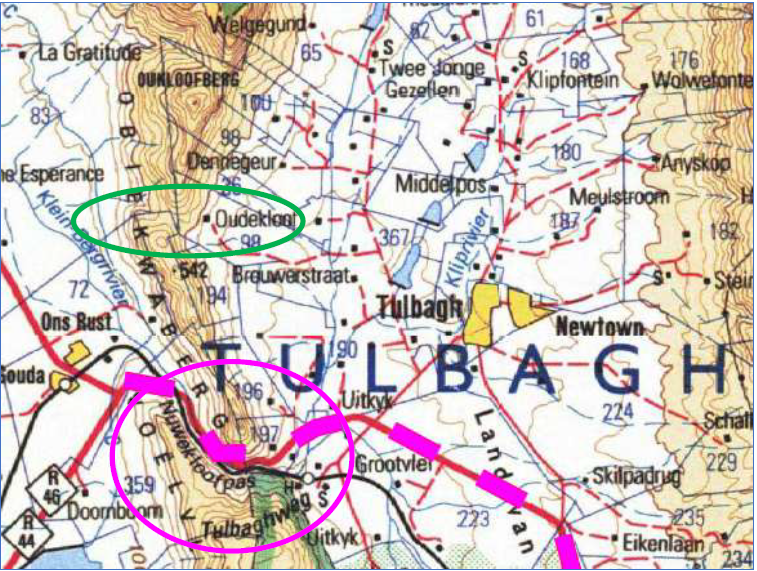
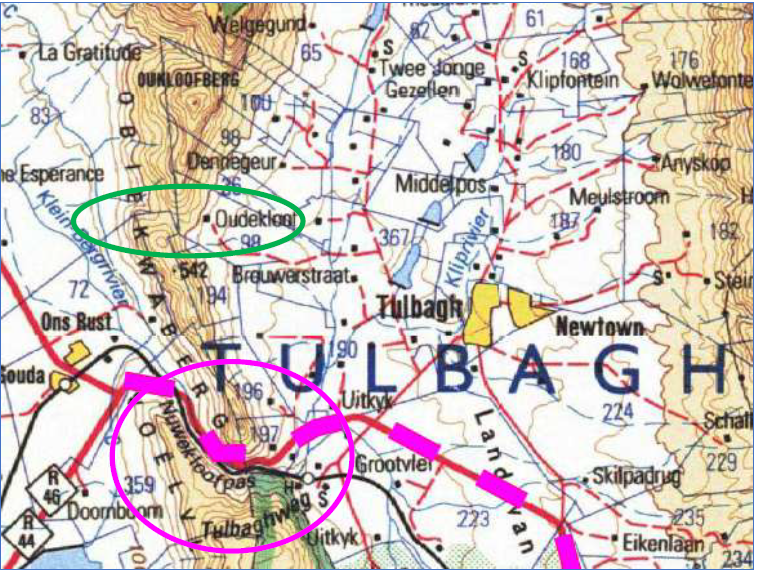
Here several men suffered a bout of dysentery, and so Van Harwarden sent the Surveyor, Pieter Potter, ahead to find a passage across the Oubiqua Mountains. On about 5 March 1658, Pieter Potter found a pass – and became the first white person to look upon the Tulbagh Basin. This was called Oudekloof Pass. In those days, the Tulbagh Valley was called Roodezand (red sand) Valley, or The Land of Waveren.
It was a tough journey from Cape Town. At least two of the party had died – one from illness, and one had been mauled by a lion. Fifty years later, Governor van der Stel used the same pass to travel to Tulbagh.
Entering the Tulbagh Valley: The Green circle denotes the Oudekloof Pass, while the pink circle indicates the Nuwekloof Pass. {The pink dotted line indicates William Burchell's route in 1811).
Today, the Oudekloof Pass cannot be used for vehicles. It is a lovely walk across the Obiqua Mountain; to experience this, contact the Oudekloof Wine Estates.(2) The name "Obiqua" is an important reminder that this area had been inhabited by Khoi people.
For about 100 years, i.e. to the mid-1700s, the Oudekloof Pass was the main entry point to the Tulbagh Valley.
References:
1) This early history is described in Dr E.E. Mossop's
classic book, Old Cape Highways.
2) www.oudekloofwineestate.co.za
This article is an extract from "The Forgotten Highway - Resource Guide for travels" from The Forgotten Highway Route