The Riverine Rabbit – Hide and Seek Champions Since 1902
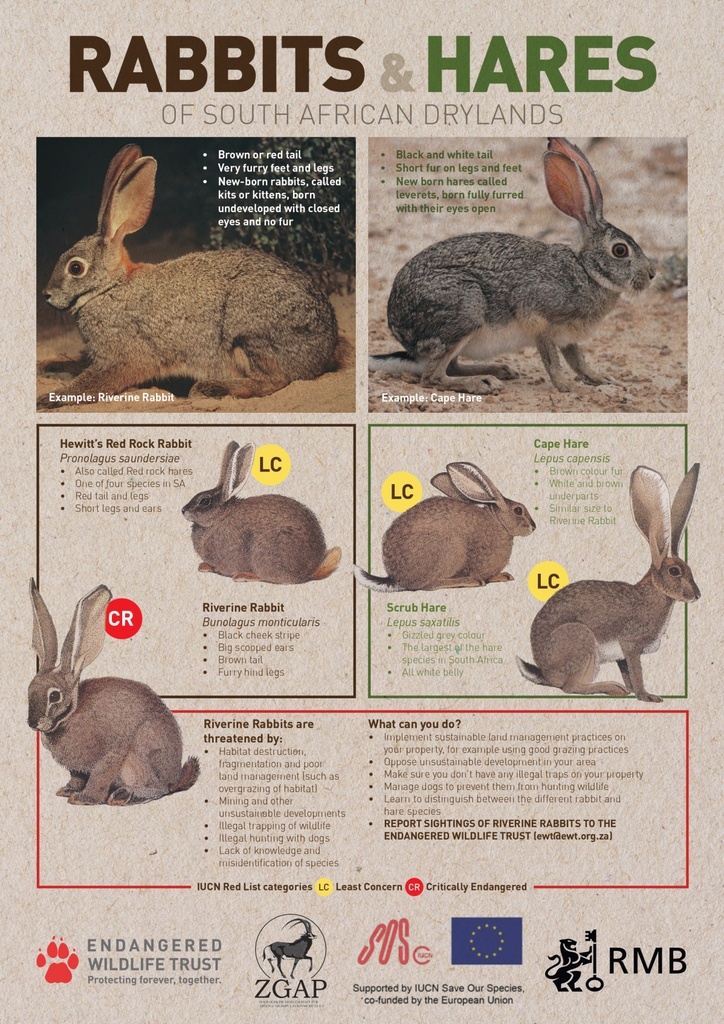
The Riverine Rabbit first attracted scientific attention in 1902 when two specimens from Deelfontein in the Cape Province were sent to the British Museum of Natural History by British trooper C.H.B. Grant. Oldfield Thomas, the Museum's zoologist, described one of the specimens as "an entirely unique species unlike anything else yet described". Initially named *Lepus monticularis* due to its hare-like appearance, the species was later renamed *Bunolagus monticularis* after further study revealed significant differences.
Thomas believed the species lived in hilly terrain, hence the name *monticularis*, meaning "little mountain". However, it was not until 1947 that Captain Shortridge, after an extensive search, identified the hare's proper habitat as the central Karoo riverine bush. Between 1947 and 1948, Shortridge collected 26 specimens along the Renoster and Vis Rivers near Calvinia.
By 1979, when researcher Robinson searched the same rivers for specimens, the riverine bush had been destroyed, leading to the local extinction of the species. A specimen was later found near Victoria West, and by 1981, surveys confirmed the extreme rarity of the Riverine Rabbit. As a result, it was listed as endangered in the IUCN Red Data Book, prompting calls for conservation action.
In 2003, what is now known as the southern Riverine Rabbit population was discovered around the Robertson, Montagu, and Touws River areas.
The Riverine Rabbit is one of the world's most endangered mammals, and its survival depends on protecting its fragile Karoo habitat. 🐇🧡
The EWT uses genetic research and habitat conservation to identify new populations and expand protected areas for this rare species.
Souces:
- Population status and distribution modelling of the critically endangered Riverine Rabbit (Bunolagus monticularis). by Kai Collins
- The Ecology of the Riverine Rabbit Bunolagus monticularis. Thesis submitted in partial fulfilment of the degree MSc Zoology, Andrew Graeme Duthie, March 1989.
- Endangered Wildlife Trust website: https://ewt.org/wp-content/uploads/2022/09/Riverine-Rabbit-fact-cards.pdf
- On a remarkable new hare from Cape Colony ." Journal of Natural History, 11(61), pp. 78–79 by Oldfield Thomas (https://www.ndsu.edu/pubweb/~rider/Pentatomoidea/PDFs/D/Distant_1903b.pdf)