Karoo Vulture Save Zone


During the mid-20th century, it was not uncommon to see vultures foraging throughout the Karoo, soaring over farms and feeding on carcasses of sheep, cattle or horses. Within the last 50 years, the Cape Vulture (Gyps coprotheres) population residing within the Karoo has plummeted to the point that the only individuals seen are those exploring and roosting in the summer months. All historical breeding sites have since been abandoned.
As with many other species, vultures are, more often than not, affected by anthropogenic threats. These include risks of collisions or electrocution by energy infrastructure, drowning in farm reservoirs, lead poisoning and, the most prominent threat in Africa at this time, poisoning using agrochemicals. Poisoning can be either intentional or unintentional, but both have the potential to kill dozens, if not hundreds, of vultures in a single event.
Intentional poisoning is driven by poaching and muthi-based belief for which vultures are the intended victims. Sentinel poisoning is the name given to the action of poisoning vultures to avoid them alerting anti-poaching patrols and rangers to the presence of a carcass. The poisoning of vultures for the muthi based trade is driven by the belief that one will receive clairvoyant talents by eating vulture brains, such as knowing the Lotto numbers.
Unintentional poisoning is the broad term used to describe incidents when vultures fall victim to poisons that are usually used to target other ‘problem animals’, such as predators that kill livestock or herbivores that damage crops. Vultures can either feed on the poisoned carcass intended for the predator and become primary victims or feed on the animal that has eaten the poisoned bait and become secondary victims. Either way, vultures face a major threat of poisons in the landscape, whether it is intended for them or not.
Understanding these threats and their underlying causes is the first step in removing them from the landscape and slowing the rapid rate at which our vulture populations are falling. The past decade has seen landowners around Graaff Reinet and nearby towns realising the importance of vultures in the ecosystem and finding ways to recover the lost population of Cape Vultures. After a few years and many conversations, stakeholders came together, and the Karoo Vulture Safe Zone Project was born.
Vulture Safe Zones are a conservation action under the Multi-Species Action Plan to conserve African and Eurasian Vultures. They are specified geographic areas in which partners used targeted conservation methods to address key threats to relevant vulture species and complement existing conservation efforts such as monitoring and rehabilitation to promote population recovery and stabilisation.
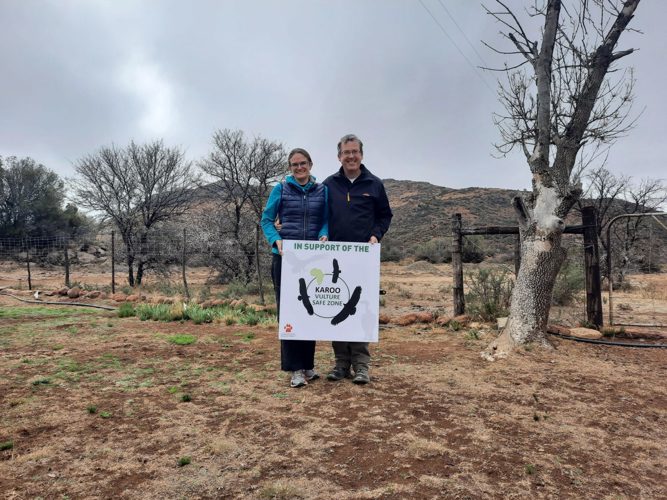
The Karoo Vulture Safe Zone (KVSZ) is a project in which Karoo farmers and other landowners have partnered with the Endangered Wildlife Trust, the Rupert Nature Foundation, South African National Parks (SANParks), the Mountain Zebra Camdeboo Protected Environment, and the SANParks Honorary Rangers. The project aims to work with partners to create a safe area across 23,000 km² from Cradock to Beaufort West, encompassing protected areas such as the Mountain Zebra National Park, the Camdeboo National Park, the Karoo National Park, and the Mountain Zebra Camdeboo Protected Environment. Our long-term goal is to encourage Cape Vultures back to their historical roosting and breeding sites in the Great Karoo and ultimately recover this population by establishing a Vulture Safe Zone (VSZ) that links these key protected areas.
The project has two phases. In Phase One, we actively engage with landowners in the protected area by conducting surveys to identify the threats to Cape Vultures on individual properties. Once these threats have been identified, we enter Phase Two, during which we implement active mitigation of these threats by working with landowners to make their properties threat free and ‘vulture safe’. The two phases are completed in tandem, working with individual landowners throughout the process to ensure that once the survey is completed, mitigation can start almost immediately. It is important to note that the process we go through with landowners to make properties vulture takes time and requires significant work from conservationists and landowners. The process also requires collaboration with electrical infrastructure utilities to ensure that power lines and similar are bird safe and mitigated to limit fatalities and injuries from collisions and electrocutions.
The first survey was completed in August 2020, delayed by the COVID-19 pandemic and the subsequent lockdown. More than 70 landowners have signed up to manage their properties in a vulture-friendly manner, and many more are interested. In March 2021, over 500,000 hectares have been committed to becoming vulture safe. One of the most impactful ways to achieve success in this project is by creating awareness and ensuring that it is seen for what it is: a way of working with landowners to create a safe landscape for the vultures. We are still in the early stages of this long-term project and working tirelessly to mitigate threats to Cape Vultures and many other species in the Great Karoo. August 2021 saw the first property classified as Vulture Safe, with many others in the process of becoming so. Sightings throughout the project area have been recorded, some of which included as many as 70 birds in a sighting.
With the commitment of landowners to this project and the fact that they were the ones to initiate it in the first place, we hope that the Cape Vulture will soon grace the landscapes of the Karoo once more.
For more information on the Karoo Vulture Safe Zone project, please contact Danielle du Toit on email: danielled@ewt.org.za