Kapokbos
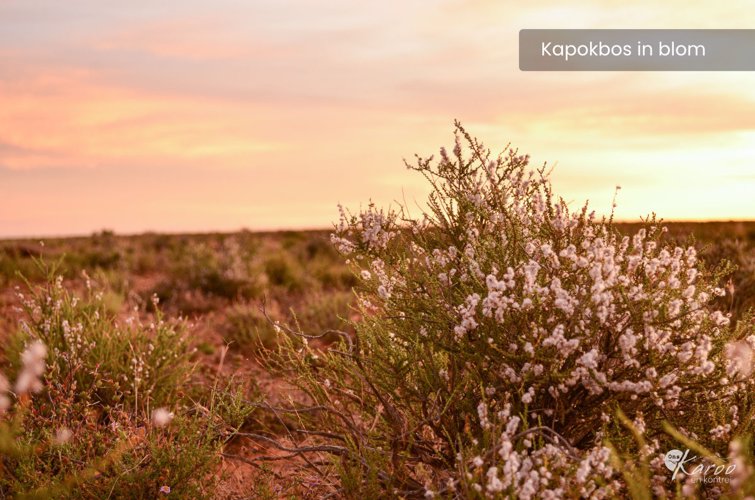
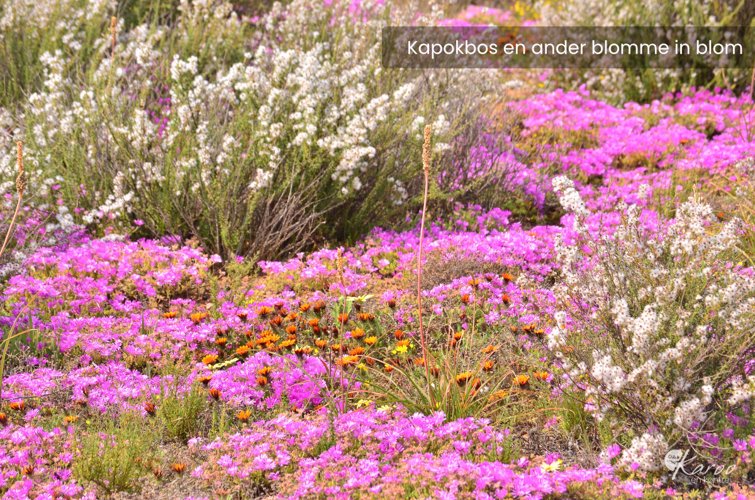
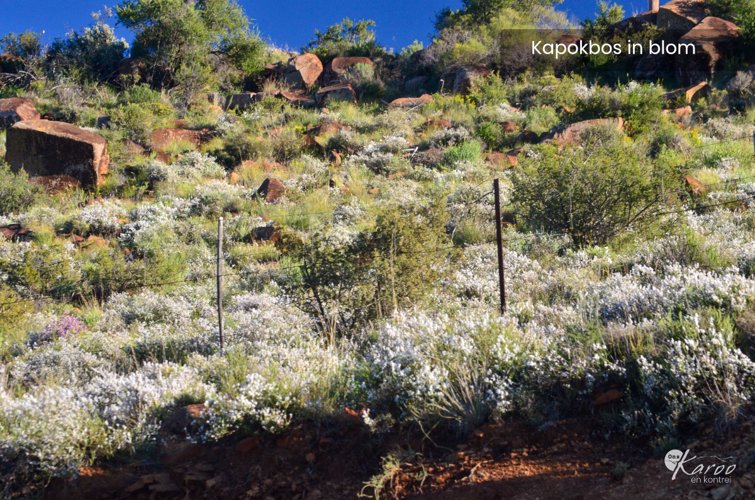
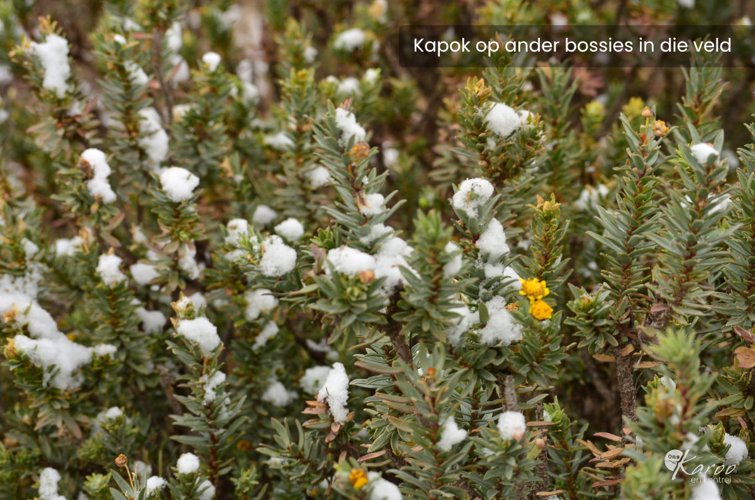
The Kapokbos are easily recognizable by their downs. When downs appear is strongly related to rainfall so summer and winter rainfall regions are different.
The genus name of the Kapokbos is Eriocephalus and comes from Greek; erion, = wool and kephale, = head; which refers to the characteristic woolly fruit buds.
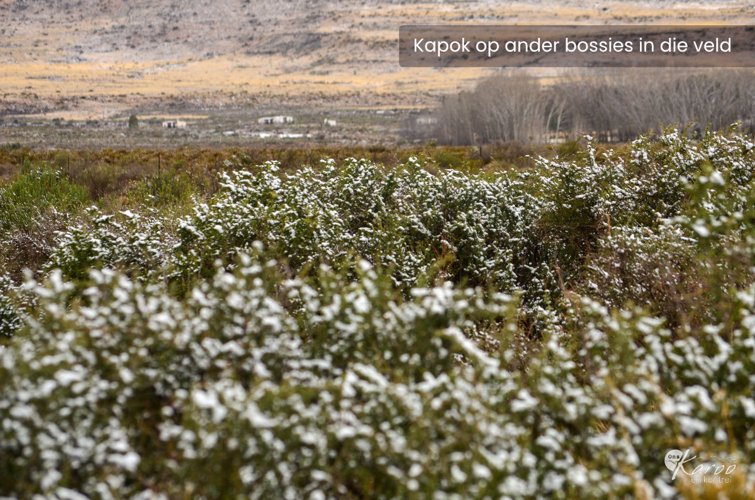
The folk name Kapokbos is very noticeable if you have only driven through the Karoo when it has kapok/snowed. In the photos, we have for you an example of what kapok looks like on the bushes in the field. And if you compare it to the Kapokbos itself, you soon understand where it got its name from.
There are several relatives, Common Kapokbos, Doringkapokbos Karookapok, Booguekapok and several others, each with its own value.
Sometimes the Kapokbos is referred to as Wild Rosemary, and you can see and smell the relationship, but the Rosemary you buy in the store and Wild Rosemary are not related.
However, the use of the Kapokbos in food was a common practice by the Khoi-San. Eve Palmer explains that she just hangs the small bushes upside down to dry and then uses the Kapokbos' dry leaves like any other herb in your kitchen, and can easily serve as a substitute for Rosemary.
Interestingly, the Kapokbos is one of the scrubs identified as the food that the sheep in the Karoo veld graze on which gives Karoo meat that fragrant taste.
The Khoi-San also used the Kapokbos for various medical reasons, such as to increase sweating and the flow of urine, and sometimes as cold and colic remedies. It also seems to stimulate hair growth, which ironically is also a characteristic of the real Rosemary.
It is also said that the down was harvested to stuff pillows with. The delicious scent, yet stretches is repellent for fleas and lice.
Eriocephalus punctulatus is also called Cape Chamomile and is used internationally as an essential oil. For those who are looking for more scientific information, there is a thesis that someone did to explain the chemical value of the genes, very interesting. And just once again a reminder that we still know so little about all the wonderful plants that grow here in our field.
Sources:
- Anon., 2023. Nama-Karoo Plants and Veld phone application, s.l.: Loaraine Van Den Berg.
- Anon.,
n.d. [Online] Accesses 12 Jan 2024
Available at: https://pza.sanbi.org/eriocephalus - Anon.,
n.d. Plant names. [Online] Accesses 12 Jan 2024
Available at: https://www.plantnames.co.za/genus_family.php?family=18 - Njenga, E. W., 2005. The chemotaxonomy, phylogeny and Biological activity of the genus Eriocephalus l. (asteraceae), Johannesburg: Thesis, University of the Witwatersrand.
- Palmer, E., 1985. In: The South African Herbal . Kaapstad: Taferberg.
- Wyk, B.-E. v., Available online 25 July 2008. A review of Khoi-San and Cape Dutch medical ethnobotany, s.l.: Journal of Ethnopharmacology.